Recurring revenue can grow even as churn, weak activation and rising acquisition costs weaken its quality. Practical analytics helps leadership understand what is driving MRR and where to invest next.
Most SaaS businesses already track MRR, ARR, new customers, pipeline and overall churn.
These numbers show that the business grew but not necessarily whether that growth is sustainable.
Leadership still needs to understand:
Discover what SaaS analytics can reveal beyond MRR and ARR.
Most leadership teams already track:
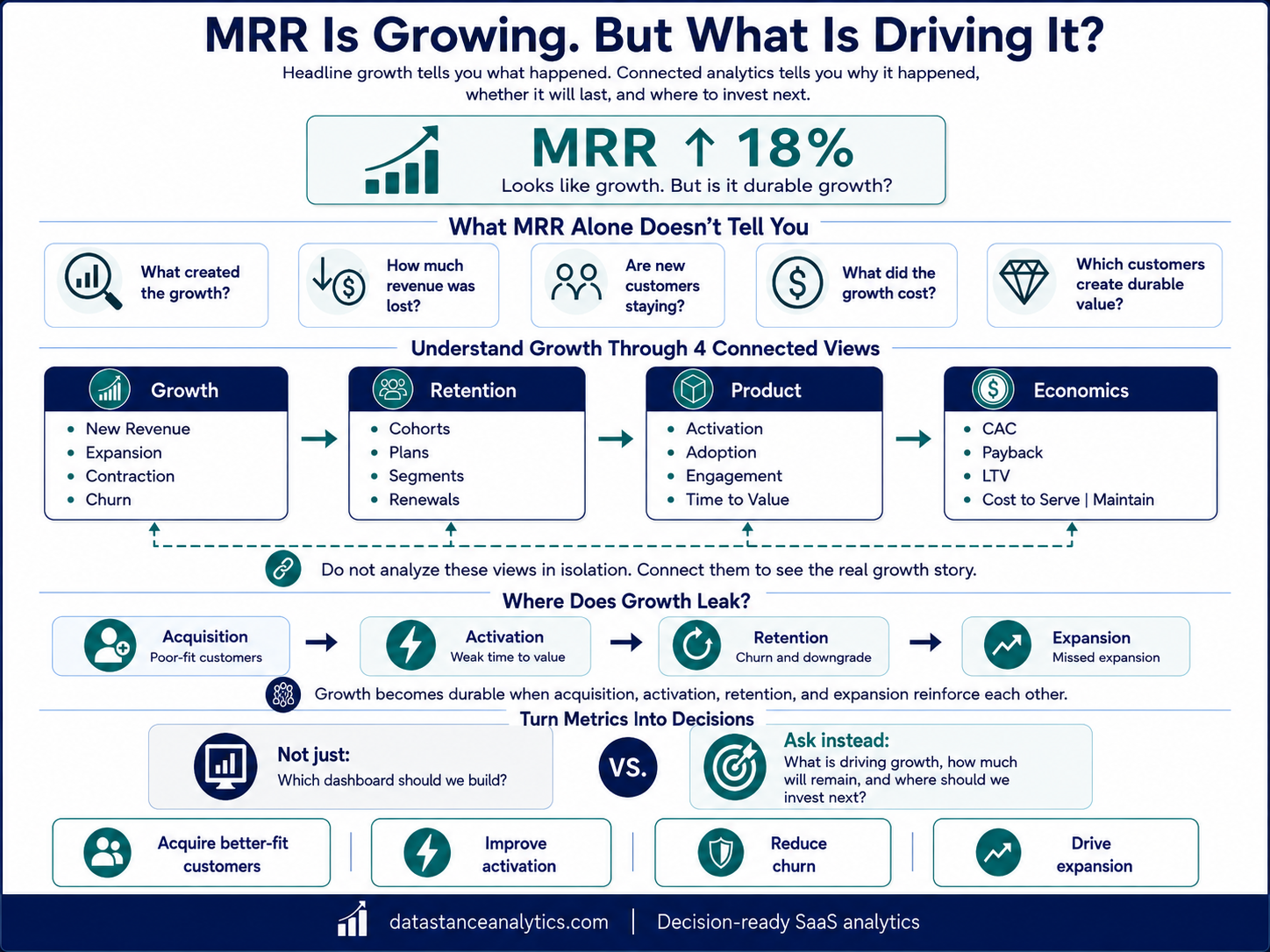
An 18% increase in MRR can come from new customers, upgrades, price increases or improved retention.
Growth may be less durable than it appears when:
The headline number shows that MRR increased but not what drove the growth, how much is likely to remain or what it cost to create.
A practical SaaS growth strategy connects four perspectives:
The goal is not a more detailed SaaS dashboard. It is clearer decisions.
Leadership should be able to identify:
Instead of simply knowing that MRR increased, leadership can understand what created the growth, which customers are likely to stay and where the next investment should go.
A practical SaaS data strategy does not begin with:
“Which dashboard should we build?”
It begins with:
“What is driving our growth, how much of it is likely to remain and where should we invest next?”
That is the difference between reporting SaaS growth and using analytics to shape it.
You don’t need a big team or a heavy rebuild to get value. We’ll begin with 1–2 questions your business actually needs answered and build only what you’re ready to use.
Free • No obligation • Practical next steps